
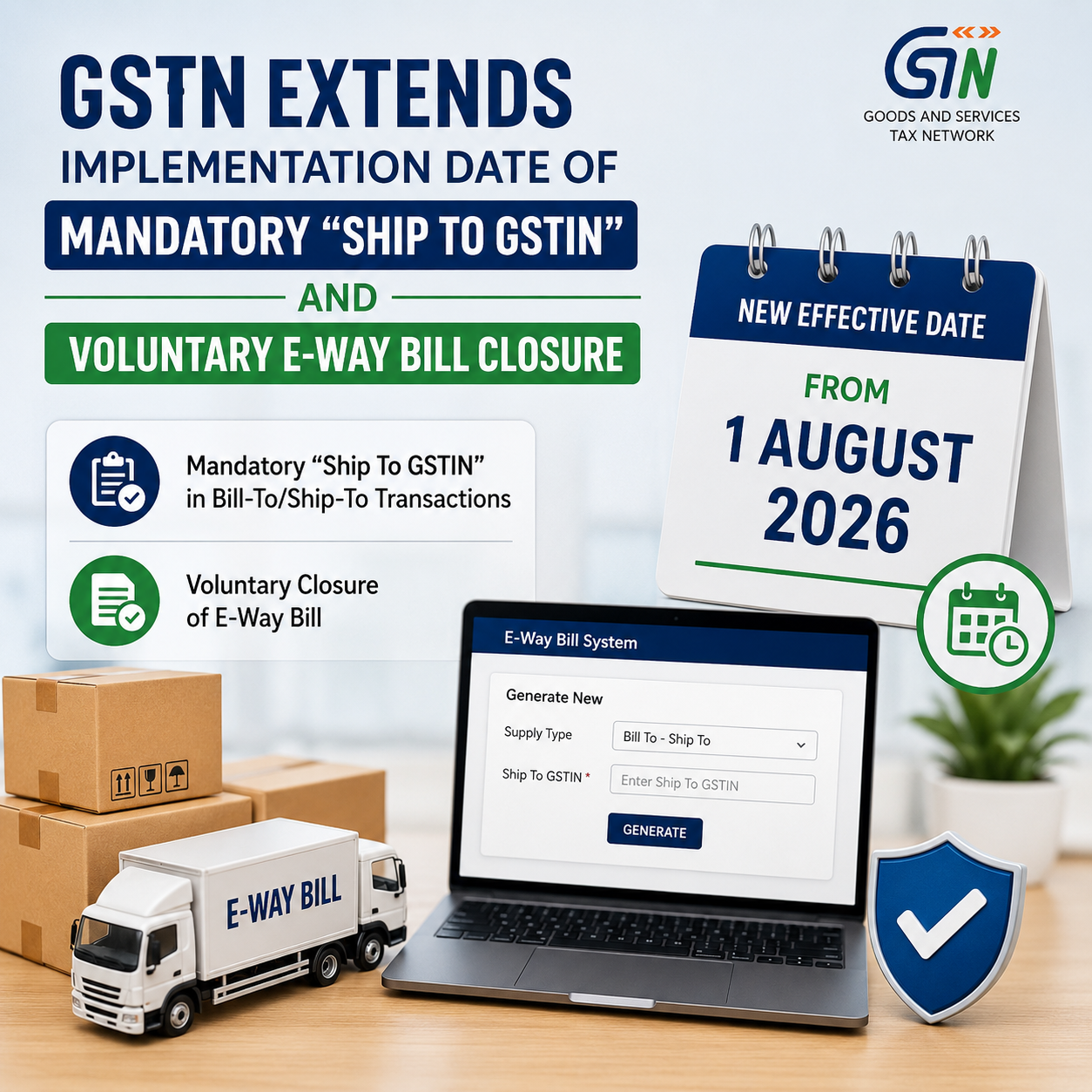

Mandatory “Ship To GSTIN” Entry and Voluntary E-Way Bill Closure Features Delayed by GSTN
Relief for Businesses: GSTN Provides Additional Time for System Preparedness
In a welcome move for taxpayers, transporters, GST Suvidha Providers (GSPs), ERP solution providers, and other stakeholders, the Goods and Services Tax Network (GSTN) has postponed the rollout of two key E-Way Bill enhancements that were originally scheduled to take effect from 15 June 2026.
According to the latest GSTN advisory released on 9 June 2026, the implementation of the following features has been rescheduled and will now come into force from 1 August 2026:
- Mandatory reporting of “Ship To GSTIN” in Bill-To/Ship-To transactions.
- Facility for Voluntary Closure of E-Way Bills.
Why Was the Implementation Deferred?
Earlier, through an advisory dated 20 May 2026, GSTN had announced that these functionalities would be introduced from 15 June 2026. Following the announcement, several industry bodies, businesses, ERP vendors, and other stakeholders highlighted the need for additional preparation time before the changes could be implemented smoothly.
The requests primarily cited the need for:
- Upgrading and modifying existing software systems
- API development, integration, and testing
- Necessary changes in ERP applications
- Correction and validation of master data
- Training of users and operational teams
- Ensuring overall system readiness
Taking these concerns into account, GSTN has extended the implementation timeline by around six weeks, providing stakeholders with sufficient time to complete the required technical and operational preparations before the new requirements become mandatory.
1. Mandatory Reporting of “Ship To GSTIN” in Bill-To/Ship-To Transactions
As part of the proposed enhancement to the E-Way Bill system, taxpayers involved in Bill-To/Ship-To transactions will be required to mention the GSTIN of the actual consignee (Ship-To party) while generating E-Way Bills.
This measure aims to:
- Improve the quality and accuracy of transaction data
- Minimize reporting discrepancies and mismatches
- Create a stronger and more reliable audit trail
- Increase transparency in the movement and delivery of goods
Businesses using accounting, billing, or ERP software should use the extended timeline to ensure that the necessary Ship-To GSTIN fields are incorporated and functioning correctly before the revised implementation date.
2. Introduction of Voluntary E-Way Bill Closure Facility
GSTN is also set to launch a new feature enabling taxpayers to voluntarily close an E-Way Bill in specified situations where the movement of goods does not take place or the E-Way Bill is no longer required.
The proposed facility is expected to offer several benefits, including:
- Greater control over E-Way Bill management
- Prevention of misuse of inactive or unused E-Way Bills
- Better compliance tracking and monitoring
- Improved reliability of logistics and transportation records
Further procedural instructions and operational guidelines are likely to be issued by GSTN before the feature becomes effective.
Revised Implementation Schedule
| Particulars | Earlier Effective Date | Revised Effective Date |
|---|---|---|
| Mandatory reporting of Ship-To GSTIN in Bill-To/Ship-To transactions | 15 June 2026 | 1 August 2026 |
| Voluntary E-Way Bill Closure Facility | 15 June 2026 | 1 August 2026 |
What Taxpayers Should Do Now
Taxpayers should make the most of the additional time provided by GSTN and undertake the following activities:
✅ Upgrade ERP, billing, and accounting applications
✅ Validate and test E-Way Bill API integrations
✅ Review and update customer and consignee GSTIN master data
✅ Conduct training sessions for GST, accounts, and logistics personnel
✅ Coordinate with GSPs, ERP providers, and software vendors
✅ Perform end-to-end testing to ensure readiness before 1 August 2026
Proper preparation during this extended period will help businesses achieve a smooth transition and avoid compliance issues once the new E-Way Bill requirements become operational.